
Introduction
WHEN THE VOICE FALTERED—AND A NATION FINISHED THE SONG: ALAN JACKSON'S MOST HUMAN NIGHT ON STAGE
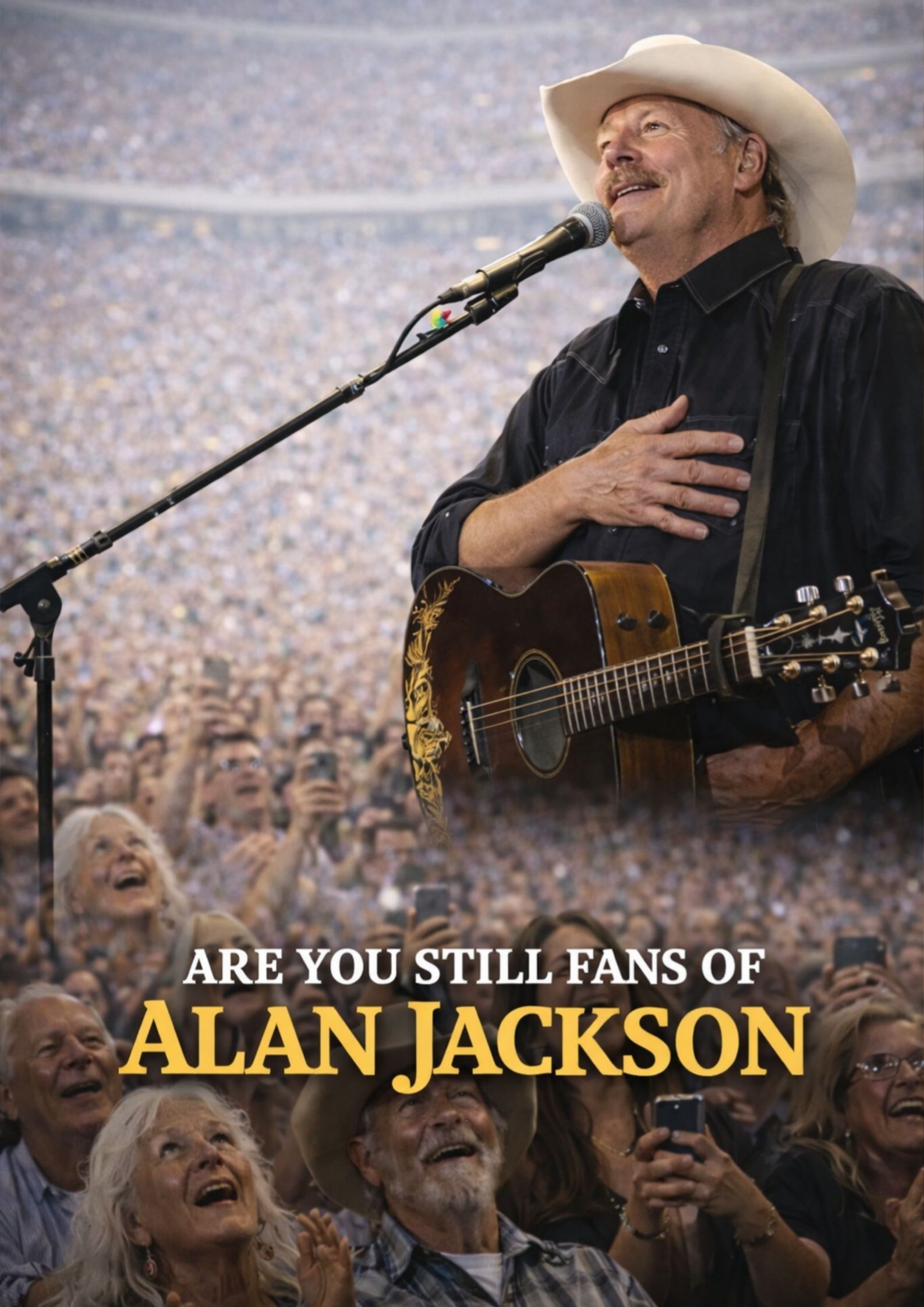
There are moments in country music that slip beyond performance and settle into something far more enduring—something closer to shared memory than entertainment. One such moment came quietly, without warning, when Alan Jackson stood beneath soft arena lights and discovered that, after a lifetime of singing to America, America was ready to sing back.
It wasn't planned. It wasn't rehearsed. And that is precisely why it mattered.
For more than four decades, Alan Jackson has been a steady hand in a genre that often changes with the wind. His songs never chased trends; they honored truth. Whether he was reflecting on small-town life, the sacred weight of family, or the quiet resilience found in faith and heartbreak, Jackson built a catalog that felt less like a collection of hits and more like a companion to everyday living. His voice—unadorned, sincere, unmistakably Southern—became something people trusted.
And trust, over time, becomes something deeper. It becomes belonging.
That is what made that particular night so unforgettable. As he began a familiar song—one that had likely played at weddings, funerals, long drives, and quiet Sunday afternoons across the country—there came a moment when his voice wavered. Not dramatically. Not theatrically. Just enough to reveal the human being behind the legend.
For a split second, the arena fell into a kind of sacred stillness.
But what followed was not silence.
It was a rising tide of voices—thousands of them—picking up the words he could not finish alone. Not to take over. Not to perform. But to support. To carry. To return something that had been given to them, song by song, year after year.
In that instant, the usual direction of music shifted. For decades, Alan Jackson had been the one offering comfort, telling stories, and giving voice to emotions many could not express on their own. But now, the roles were reversed. The audience became the storyteller. The crowd became the chorus.
And perhaps, for the first time in a long time, the artist simply listened.
For older listeners—those who have measured life not in years, but in moments like these—the significance is impossible to ignore. This was not about a missed lyric or a faltering note. It was about what happens when music has lived long enough inside people that it no longer belongs to the one who wrote or recorded it.
It belongs to everyone.
That arena was not filled with fans in the traditional sense. It was filled with witnesses. People who had carried Alan Jackson's songs through the most meaningful chapters of their lives. Couples who first danced to his melodies decades ago. Parents who played his records while raising children now grown. Individuals who found quiet strength in his lyrics during seasons when words were hard to find.
So when his voice paused, they did not hesitate.
They knew the words—not because they memorized them, but because they had lived them.
And that is the quiet miracle at the heart of this story. Longevity in music is often measured in awards, chart positions, or ticket sales. But nights like this reveal a different metric entirely. Legacy is measured in how deeply a song embeds itself into the lives of ordinary people. In how quickly a crowd can rise—not out of excitement, but out of recognition.
Recognition of shared history.
Recognition of gratitude.
Recognition of a man who never needed to shout to be heard.
There was no grand gesture at the end of that moment. No dramatic speech. No attempt to define what had just happened. Because moments like that resist explanation. They are felt, not analyzed.
But if one were to try, it might sound something like this:
After forty years of singing for America, Alan Jackson reached a point where he no longer had to carry the song alone.
And in return, America showed him that he never had.
That is the kind of moment that lingers long after the lights go down and the stage empties. Not because it was perfect, but because it was real. Because it revealed something essential about the relationship between an artist and the people who have walked beside him through time.
In the end, the most powerful legacy a musician can leave behind is not fame. It is fellowship.
It is the knowledge that when the voice grows quiet—even for a moment—there will be thousands ready to carry the melody forward.
And on that night, as the final notes drifted into memory, it didn't feel like the end of a song.
It felt like the sound of a nation, gently, gratefully… singing back.